ICU Trials by ClinCalc
- 4.6
- Rating
- 10.00K
- Installs
- $4.99
- Price

 Analysis by App-foxy
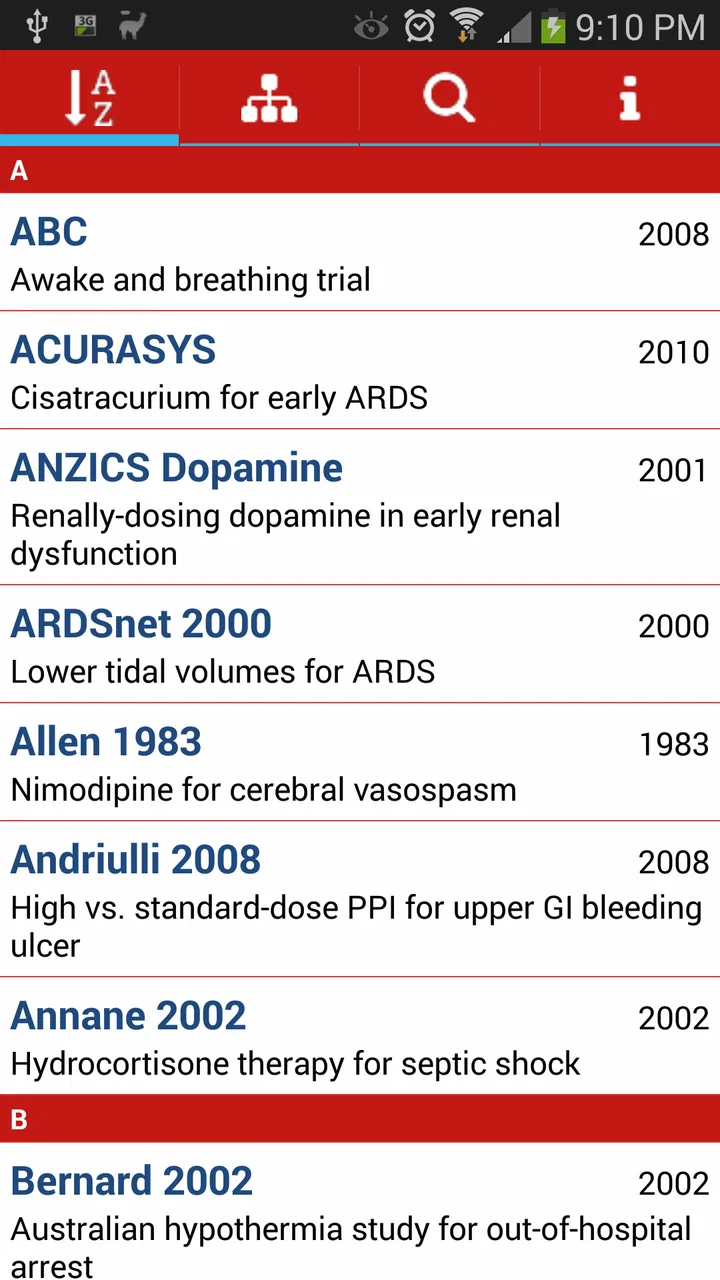
When I first opened ICU Trials, I understood its appeal almost immediately. It is a focused medical reference app from ClinCalc LLC, built around landmark critical care trials rather than broad clinical education. The idea is simple: keep important evidence summaries close at hand so I can refresh my memory without searching through papers, textbooks, or a general web search.
That narrow purpose is also the reason to take it seriously. This is not an app I would install for casual medical reading, and it is not a substitute for current guidelines, local protocols, or bedside judgment. Its value depends on whether I regularly need to recall the design and conclusions of major intensive-care studies. For that audience, the app can become a practical pocket reference. For everyone else, the purchase may feel more like collecting a specialist tool than adopting a daily habit.
What the first week feels like
The first week is where ICU Trials makes its strongest impression. Instead of presenting an enormous medical library, it concentrates on critical care trial summaries. That focus makes the app easier to approach than a general medical database when I already know the question I want to answer: Which study changed this practice? What population was examined? What intervention was compared? What outcome mattered?
You May Also Like

 Blood Strike: 2.5 Anniversary
Blood Strike’s Loadouts Turn Every Drop Into a Tactical Gamble
A close look at Blood Strike’s custom loadouts: how fast access to signature weapons reshapes its battle royale rhythm, rewards preparation, and narrows the gap between fights.

 Pandora - Music & Podcasts
Pandora’s Music Is Easy to Start, but Harder to Recover
Pandora’s strength is its low-effort path from a seed to a station. Its weak spot is how much confidence it asks you to place in connection, setup, and quiet recovery.

 8 Ball Pool
 Is Built on Rivalries, Rematches, and Routine
A close look at the rivalries, rematches, shared routines, and unanswered safety questions that turn a quick pool match into a persistent mobile community.

 Samsung Music
’s Quiet Strength Is Playing What You Already Own
Its reach comes less from spectacle than from dependable access to a personal library. That simplicity is both the app’s strongest retention engine and its ceiling.

 AccuWeather: Weather Radar
AccuWeather Review: A Quick, Clear Forecast for Everyday Decisions
For everyday plans, the best forecast is the one you can understand quickly. AccuWeather makes rain timing, radar, and local conditions easy to act on, with a few trade-offs.

 Hill Climb Racing
Why Hill Climb Racing Still Turns Crashes Into One More Run
A tiny car, a bumpy hill and one more upgrade: Hill Climb Racing keeps resurfacing because its simple chaos makes every near-miss feel personal.
More From Our News Desk
View All News


I found the format most useful during short review sessions. A trainee preparing for rounds, an intensive-care clinician revisiting a familiar controversy, or a student trying to connect a guideline recommendation with its evidence can open the app with a specific purpose. The experience is less about discovering entertainment or building a streak and more about reducing the time between a clinical question and a structured reminder of the relevant trial.
The app’s store summary describes it as landmark critical care trials at my fingertips, and that is a fair description of its role. It does not try to be a full medical encyclopedia. That restraint is helpful during the first few uses because I am not forced through unrelated subjects. I can treat it as a compact evidence index, moving from a topic I recognize to a concise review of the study behind it.
One useful workflow is to use it before reading a longer paper, not instead of reading one. I can first use a summary to identify the trial’s clinical question and main result, then decide whether the original publication or a current review deserves deeper attention. This prevents a common mistake with quick-reference tools: confusing a convenient summary with the entire evidence base.
The app is available for Android, with a minimum operating-system requirement of Android 8.0. It is rated for Everyone, so its audience classification is broad, although the subject matter is clearly aimed at people with a serious interest in medicine. The current version is 2026.07, which gives the product a contemporary release line rather than the feel of an abandoned reference.
At $4.99, the first-week decision is fairly straightforward. I would consider that reasonable if I were studying critical care or working in an environment where trial recall comes up often. I would hesitate if I only wanted occasional health information, because the app’s specialist focus means much of its content may sit unused.
Who gets the quickest benefit
Medical students, residents, fellows, nurses working in critical care, pharmacists, and clinicians who teach intensive-care concepts are the clearest audience. The app can help turn a vague memory into a more organized one. It is especially useful when I remember that a landmark study exists but cannot recall exactly what question it addressed or why it continues to appear in teaching discussions.
It may also suit someone preparing for an exam or presentation. A practical approach is to choose one trial summary, write down the population, intervention, comparator, and primary outcome from memory, and then check the app. That turns passive scrolling into active recall. The app itself does not need to become a complete study system; it can serve as the evidence-review portion of a larger routine.
On the other hand, I would not recommend it to a person looking for symptom advice, medication reminders, appointment management, or general wellness guidance. It is also not the right first stop for an urgent clinical decision. A summary app cannot account for a patient’s full history, evolving evidence, institutional policy, or the judgment of the treating team.
Why it can still matter after the novelty fades
The more important question is not whether ICU Trials is interesting during the first few days, but whether it earns a permanent place on my device. Specialist reference apps often have a burst of usefulness followed by long periods of neglect. Their lasting value comes from fitting naturally into an existing routine.
For me, the strongest recurring use is tied to teaching and preparation. Before a journal discussion, lecture, or bedside conversation, I can use the app to refresh the major trial connected with the topic. Afterward, I can return to the same entry when a colleague asks why a practice became influential. That kind of repeat use is more realistic than expecting to browse it every day without a reason.
A second recurring use is comparative thinking. Critical-care decisions rarely depend on a single headline result. When I review a trial, I want to ask whether its participants resemble the patient or setting in front of me, whether the outcome was clinically meaningful, and whether later evidence has changed the interpretation. ICU Trials is most valuable as the starting point for those questions. Its compact format encourages recall, but it should also remind me to look beyond the first memorable conclusion.
There is a subtle advantage in having trial summaries separated from the noise of a web search. Online searches often mix primary research, opinion pieces, educational pages, and outdated explanations. A dedicated app gives me a more deliberate entry point. I can review the study I intended to review instead of losing time to unrelated results.
That advantage has a limit. A focused reference is only as useful as the scope and currency of its material. Even when an entry remains accurate, medical interpretation can evolve through later trials, subgroup analyses, systematic reviews, and changes in guidelines. I would therefore keep the app in my evidence-refresh toolkit, not treat it as the final authority.
A realistic monthly routine
Someone deciding whether to keep the app installed should build a modest routine rather than rely on enthusiasm. I would choose one critical-care topic each week, review the related trial summary, and write a short note about what changed in practice and what limitation matters most. At the end of the month, I would revisit the notes and identify which studies still influence my thinking.
This approach creates recurring value without pretending that a reference app needs to be opened constantly. It also exposes an important trade-off: the app may be excellent for refreshing known landmarks, but less satisfying if I want a guided curriculum. A textbook, course, or structured question bank is better for progressive learning because it gives sequence and accountability. ICU Trials works better as a flexible companion.
The app’s audience size suggests that it remains a niche product rather than a mass-market medical utility. It has more than ten thousand installs, an average rating of 4.6 from around two hundred ratings, and sixteen written reviews. Those figures indicate a generally positive reception, but they also reinforce my impression that this is a specialist purchase. I would read the rating as encouragement, not as proof that it fits every medical learner.
Where the maintenance burden appears
The main maintenance burden is not complicated setup. It is the responsibility to remember what the app is—and what it is not. If I use it as a rapid evidence refresher, it stays manageable. If I expect it to replace current literature searches, guidelines, or local protocols, the burden becomes much heavier because I would constantly need to verify context elsewhere.
There is also a personal maintenance issue: keeping the summaries connected to real questions. Without a clinical, teaching, or study routine, the app can become an icon I rarely open. The content is specialized enough that casual browsing may not create a lasting habit. I get more from it when I attach it to rounds preparation, exam revision, or a scheduled journal-club topic.
Because the app costs $4.99, the maintenance question is really about frequency of relevance rather than subscription management. A one-time purchase can be easier to justify than a recurring expense, but it still deserves an honest assessment. If I only encounter critical-care trial questions a few times a year, a library resource or a trusted online reference may be more practical. If the topic appears in my work or studies every week, the small purchase becomes easier to defend.
I also would not assume that an updated version number alone settles the question of evidence maintenance. The current version, 2026.07, is useful context when assessing the app’s present state, but medical users should still check the publication dates and current recommendations relevant to a decision. An app update and an update to clinical consensus are not the same thing.
What can cause fatigue over time
The first source of fatigue is repetition without a clear goal. Reading summaries simply because they are available can quickly feel like reviewing flashcards with no exam or patient question attached. The remedy is to open the app with a narrow purpose: confirm a trial’s population, revisit an outcome, or prepare to explain the evidence to someone else.
The second is the compression itself. Concise summaries are convenient, but compression removes nuance. I may remember the headline result while forgetting inclusion criteria, exclusions, statistical uncertainty, or how the intervention was actually delivered. That is not a flaw unique to this app; it is the unavoidable cost of a quick reference. The app is strongest when it prompts deeper reading, and weakest when I ask it to carry the entire interpretation.
The third is the possibility of a mismatch between landmark status and present-day usefulness. A famous trial can remain educational while no longer answering the precise question I face. A current patient may differ in severity, background treatment, technology, or goals of care. I need to resist the temptation to use familiarity as a shortcut for applicability.
Another point of friction is audience. The Everyone age rating makes the app broadly accessible, but accessibility does not make the subject simple. A beginner may recognize the terms without understanding the clinical implications. I would pair the app with teaching from a qualified professional or a dependable textbook if I were early in my training.
For experienced clinicians, the fatigue may come from wanting more depth than a compact app can provide. In that situation, a guideline database, full-text journal access, or a literature-search tool may be the better primary resource. ICU Trials can still function as an index or memory aid, but it should not be forced into a role designed for another kind of product.
How it compares with usual alternatives
Compared with a general search engine, ICU Trials offers a calmer and more targeted route to landmark critical-care evidence. The trade-off is breadth. A web search can uncover newer studies, guidelines, commentaries, and patient-specific material, while the app’s appeal lies in keeping attention on major trials.
Compared with a textbook, it is faster to consult and easier to use for a single question. A textbook is better for explanation, sequence, diagrams, and comprehensive background. I would use the app when I need a quick evidence reminder and the textbook when I need to understand the physiology, controversy, or historical development around that evidence.
Compared with a question bank, ICU Trials is less motivating for structured revision. A question bank tests whether I can apply knowledge and exposes gaps through feedback. This app is better for building a mental map of influential studies. The two tools can complement each other, but neither replaces the other.
Compared with a current guideline resource, it offers a different perspective. Guidelines tell me how expert groups translate evidence into recommendations; trial summaries help me remember the studies that shaped the field. When the two seem to point in different directions, I would investigate rather than choose whichever is more convenient.
My long-term verdict
ICU Trials earns lasting space when it is used as a deliberate evidence refresher, not as an all-purpose medical authority. I can see myself keeping it installed if critical care is part of my training, teaching, or regular clinical work. Its focused subject matter, compact purpose, and modest one-time price make it easier to return to than a sprawling reference library.
I would skip it if I wanted general health information, a guided learning course, current bedside recommendations, or a tool that creates a daily habit by itself. The app does not remove the need to read original research or consult current guidance, and its concise nature can encourage overconfidence if I forget to check context.
ClinCalc LLC has made a specialized app for a specialized need. My recommendation is therefore conditional but positive: if you frequently ask which landmark trial supports a critical-care practice, this is a convenient way to keep those studies close. If that question rarely appears in your work or studies, the novelty will probably fade before the purchase becomes worthwhile.
For the right user, the app’s lasting value is not constant novelty. It is the quiet usefulness of having a focused evidence reference ready before rounds, a teaching session, an exam review, or a difficult conversation about what a study actually showed. That is a narrower promise than a complete medical library, but it is also the reason the tool can remain useful long after the first week.
FAQs for ICU Trials by ClinCalc
01What is ICU Trials by ClinCalc used for?
ICU Trials by ClinCalc is an educational reference app for healthcare professionals, students, and anyone interested in critical care medicine. It summarizes important intensive care clinical trials, including their study questions, patient populations, interventions, outcomes, and practical conclusions. It is especially useful for quickly reviewing landmark evidence when studying, preparing for discussions, or refreshing knowledge during clinical work.
02Does ICU Trials by ClinCalc provide medical advice or treatment recommendations?
No. The app is designed as an educational and evidence-review resource, not as a substitute for clinical judgment, institutional protocols, official guidelines, or consultation with a qualified healthcare professional. Trial results may not apply to every patient, and medical decisions require consideration of the complete clinical situation, current evidence, contraindications, and local practice standards. Always verify important information before using it in patient care.
03What type of clinical trials and topics are included?
The app focuses primarily on influential and practice-changing trials in critical care and intensive care medicine. Depending on the available content, users may find summaries related to resuscitation, sepsis, mechanical ventilation, sedation, cardiovascular support, renal replacement therapy, nutrition, and other ICU topics. The collection is intended to make major studies easier to review, although it should not be assumed to contain every published trial or the newest evidence.
04Is ICU Trials by ClinCalc suitable for medical students and non-specialists?
Yes, the app can be useful for medical students, residents, pharmacists, nurses, physicians, and other learners who want a structured introduction to important ICU research. However, some summaries use clinical terminology and assume a basic understanding of medicine and critical care. Beginners may need to consult textbooks, guidelines, or instructors for additional context, while experienced clinicians may use the app as a convenient quick-reference tool.
05Can I rely on the app for current information, and does it work offline?
ICU Trials by ClinCalc can be convenient for reviewing trial summaries, but users should check when the content was last updated and compare important information with the original publications or current guidelines. Medical evidence changes over time, and a historical trial summary may not reflect today’s standard of care. Availability of offline access, search functions, and updates can depend on the app version and device platform.
Pros
- Quickly estimates ICU mortality risk with validated clinical scoring tools.
- Includes calculators for several common critical-care prediction models.
- Clear input fields make bedside data entry relatively straightforward.
- Useful for teaching
- case discussions
- and reviewing prognostic factors.
- ClinCalc’s medical references add context to many of the calculations.
Cons
- Results depend on accurate clinical data and should not replace medical judgment.
- Some scores require laboratory values that may not be immediately available.
- The interface may feel dated compared with newer clinical calculator apps.
- Limited usefulness outside intensive-care
- emergency
- or academic settings.
- Users may need to verify score versions and applicable patient populations.

ICU Trials by ClinCalc
Gallery